

Armenia faces choice between ethnostate and neoliberal state: Armenian scholar on upcoming elections
June 6, 2026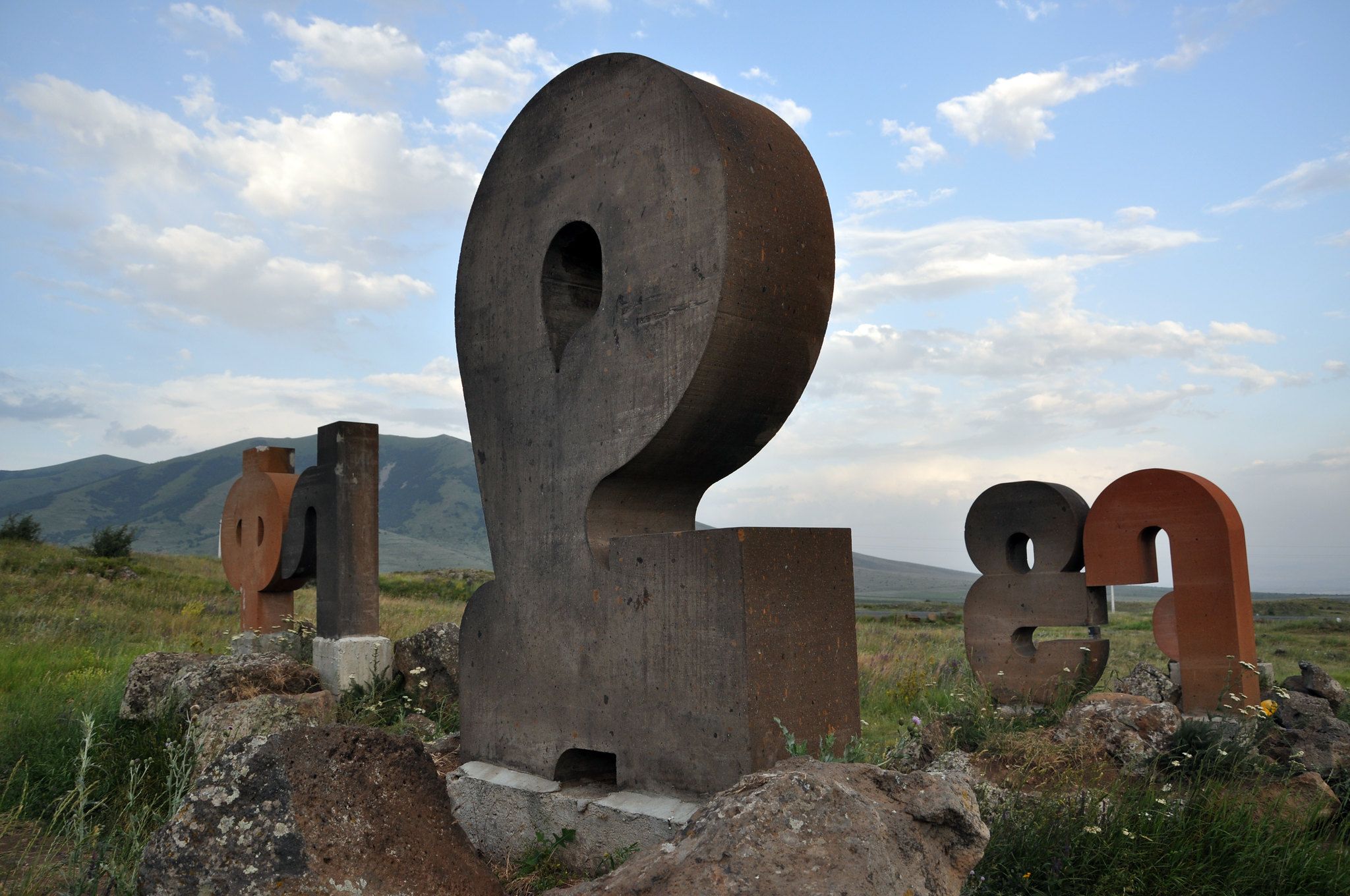
In the run-up to the 2026 parliamentary elections, Armenian people and the country’s government have increasingly found themselves in the vortex of geopolitical intrigues and great powers’ competition. September asked a socialist scholar from Armenia for an insider perspective on the economic and political situation in the country as the Civil Contract party and its leader, Nikol Pashinyan, fight for reelection amid rising internal and external pressure.
On the cover: The "Monument to the Armenian Alphabet", erected in 2005, by Nina Stössinger
On the Upcoming Elections
On June 7th, Armenia will hold its next parliamentary elections. These are the first elections since in 2023 Nagorno-Karabakh was ethnically cleansed. We are going to see elections where the grievances people experience, especially Karabakh Armenians, concerning this loss and displacement, will be shown.
These grievances have already been shown in the 2021 parliamentary elections, which happened right after the war in 2020. They were snap elections that happened because of the loss in the war and because the government at the time was going through a legitimacy crisis. But Pashinyan won the elections and won a majority, so he didn't need to ask any other party's support to form a government.
The Oligarchic Opposition and Selective Justice
Right now, we are in a similar position where we have opposition parties challenging Pashinyan on this same issue of Karabakh and security. His main opposition is three oligarchs. One is a Russian-Armenian oligarch, Samvel Karapetian. The other is the second president of Armenia, Robert Kocharyan, who also ran in 2021 and suffered a spectacular loss, even though his media and campaign had everyone convinced he was going to win; he lost by 30 points.
These are all, in a very post-Soviet sense, political capitalists. These are people who have instrumentalized the state, participated in the capture of the state, stolen from the people, and looted the Soviet state right after the fall of the Soviet Union. Robert Kocharyan, specifically, has used the militarization and securitization of the country through ethno-nationalist narratives to his own benefit. He's a billionaire in dollars, a very resourceful person.
The reason these oligarchs are running against Pashinyan and not giving up is that there is a lot of pressure on their businesses in Armenia. Pashinyan is using the state apparatus to go after their businesses under the banner of returning what was stolen from the state. However, Pashinyan is doing this very selectively. There are oligarchs in his camp who are referred to as business owners who contribute to Armenia's development by creating jobs. He is selectively applying this agenda to a few oligarchs he personally hates and has a vendetta against because he was imprisoned under Kocharyan and was an opposition politician under Serzh Sargsyan (the third President of Armenia from 2008 to 2018 - September).
For example, Khachatur Sukiasyan is part of the ruling party in parliament and one of the first oligarchs of post-Soviet Armenia. He constantly talks about neoliberal reforms that need to be done and how we can use old Soviet industrial carcasses to develop Armenia in a very capitalist sense. Other oligarchs in Pashinyan's camp pay bribes to him and his family to stay in his good graces.
The 2018 Regime Change and Relations with Russia
The relationship between Armenia and Russia is very complicated. People will have you believe that in 2018, the West orchestrated a color revolution against Moscow in Yerevan. But what happened in 2018 was very much a domestic process. The grievances the people had against the government were legitimate.
Outside factors did not drive the reasons Serzh Sargsyan resigned; he knew there was going to be a war over Nagorno-Karabakh and that Armenia was going to lose. It was very obvious in the mid-2010s. Sargsyan wanted to save his own skin and not become the one who lost that war. He saw an opening when the people had a popular candidate to become prime minister and head of state, even as the war would be fought and lost. This is why there are popular conspiracies, especially from the Kocharyan camp, that Sargsyan deliberately brought Nikol Pashinyan to power. But politics is more complicated than someone always pulling the strings.
At the beginning, the relationship with Russia was very friendly. The Russian government accepted Pashinyan and the regime change. Over the years, Armenia sent a non-combatant group to Syria to help Russia, supported Russia in the UN, and stayed neutral after the invasion of Ukraine. To say Armenia, for the past eight years, was only trying to pivot away from Russia would be a dishonest way of analyzing the situation.
Geopolitical Shifts and the Corridor
The situation completely changed after Russia invaded Ukraine and started losing influence in the South Caucasus. Azerbaijan has become geopolitically much more significant to the EU, to such a degree that it was able to talk to Moscow on more equal terms. Russia was using Armenia's interests as its security guarantor to make concessions to Azerbaijan, the final concession being Nagorno-Karabakh itself.
The Armenian government and pro-Western parties have been using this to stir anti-Russian sentiment, which Russian pro-government media has not done a lot to alleviate. The way Margarita Simonyan talks about Armenia is constantly presented as the Kremlin's real feelings, and that significantly damages the relationship between the two countries.
In August 2025, a new dimension to the regional situation was added with the signing of the TRIPP (Trump Road for International Prosperity and Peace). In the 2020 ceasefire agreement, Armenia was going to give Azerbaijan a corridor supervised by the Russian FSB. However, Armenia opposed ceding its southern border with Iran. Both Iran and the EU civilian observers played a role in suppressing Azerbaijan's urges to invade southern Armenia. The Russians hoped to use this transit route to their own benefit because the Northern Corridor was closed due to sanctions. But they weren't able to enforce whatever they wanted because they’ve been significantly weakened in this region.
That resulted in both parties bringing in a bigger imperial power, the US. A strongman like Aliyev prefers to bring a madman to the negotiation table - one who has actual imperial power, unlike the EU, which Aliyev would constantly ridicule. Washington's presence on the Iranian border complicates relationships between Yerevan, Tehran, Baku, and Moscow. As a result, Russia is using economic sanctions against Armenian products to put pressure on the electorate and signal Moscow's disapproval. There is propaganda from Armenian diaspora accounts, propaganda from the local Armenian oligarch media… Moreover, the level of propaganda against Armenia from Kremlin-related news sources is unprecedented.
Western Influence and AI Data Centers
Naturally, you also have EU grants against this wave of Russian misinformation. Civil society is also mobilized against it, constantly talking about how we need to get out of the Collective Security Treaty Organization (CSTO) and the Eurasian Economic Union. To me, it's a very premature way of understanding the world. Armenia cannot afford to alienate everyone. That whole idea that European civilization is going to come and save us is unrealistic. The EU development grants never allow for any level of nuance; it's just a very straightforward anti-Russian agenda.
On have to hope that at some point, Russia and the EU will come to the table to not only negotiate over Ukraine, but also to negotiate over the stress points that each of them has, including Georgia and Armenia. It would give people in these regions some hope that their countries would not become a theater of geopolitical power clashes between two powerful blocs.
Then you have the US unapologetically endorsing Pashinyan. They signal that they want him to stay because they have made a deal with him. Pashinyan is desperate enough to offer them critical minerals deals or allow NVIDIA to open AI data centers without any environmental assessments. When you question the local government’s decision-making regarding this, they say, "Well, it's a big international company; I'm sure they know what they're doing." That is how imperial soft power works. It has you convinced that you don't know what's best for you. I am afraid that people will only find out how bad AI data centers are after they run out of water and suffer from health complications.
The Lack of a Clear Plan
Armenia is going through a transformative period, and I'm not sure that transformation is leading us to a good place. The choice is between becoming a right-wing ethnostate, a neoliberal state with no state capacity where developed countries do whatever they want, or a place where conflict wipes your country off the map—which is what Russian propaganda has been threatening with the "Ukrainization" narrative.
I think Pashinyan will definitely win in a landslide on Sunday. I feel like Armenia should follow a complementary foreign policy, but both Brussels and Moscow are pushing Armenia to make a definite choice between the two. That risks intensified power clashes, as no one is willing to understand the geopolitical situation of Armenia.
I don't think anyone has a plan for Armenia, whether it's Russia or the US. At least with the Russians, there is a certain level of cultural understanding; Armenians understand Russian and can recognize when they are being disrespected. But when it comes to American imperialism, there are a lot of people being paid to confuse the public about the nature of foreign direct investments. There is no dissent happening right now regarding the AI data centers, and that speaks to the level of brainwashing that has happened with post-Soviet people in the past 35 years. They don’t understand that Big Tech companies don’t care for their well-being. That's why they bypassed all the environmental protections and regulations.