

Slavoj Žižek’s Not-So-Intellectual Trenches
May 6, 2026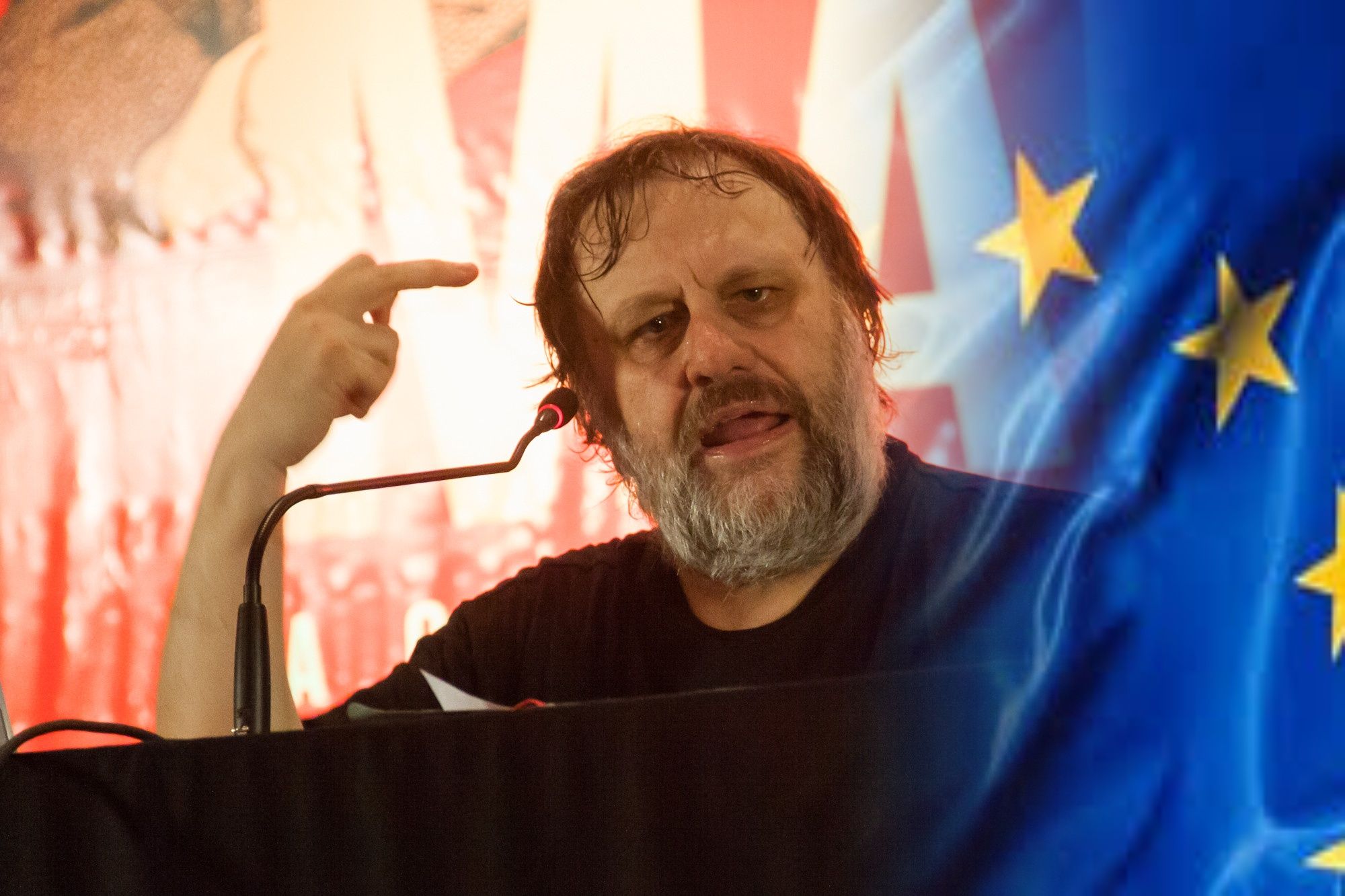
For a quarter of a century, Slavoj Žižek has been both irritating some and inspiring others, earning himself a reputation as one of the most famous intellectuals of our time. Today, he promotes a worldview in which ‘European civilisation’ must take on the role of a bulwark in the fight against the ‘axis of fascism’ and ‘religious fundamentalists’. Vladimir Metelkin explains why such a position is flawed from both analytical and practical point of view.
It is predictable and exhausting to watch a famous intellectual begin his keynote speech with a trite quote from Antonio Gramsci: "the old world is dying, and the new cannot be born; in this interregnum a great variety of morbid symptoms appear." The anxiety sets in when you realize why he is doing this. For a superstar intellectual, the figures of the classics serve merely as stage decorations for a performance—a dialectical balancing act that has been in high demand by audiences for many years.
Armed with his trademark Slovenian accent and eccentric humor, Slavoj Žižek finds ideology everywhere: in Hollywood blockbusters and in the design of Western toilets. But there is every reason to believe that in the picturesque Roman cemetery in Testaccio, Antonio Gramsci would turn in his grave seeing how Žižek handles his legacy.
It seems Žižek has long ceased to cultivate the reputation of a marginal figure—a sort of modern-day Diogenes in a barrel. Today, he is a successful intellectual, welcomed into the finest academic institutions and concert halls. He lives and works between London, Ljubljana, and the US, earning hefty fees for his speaking engagements and books, which are churned out like on a conveyor belt, sometimes two a year. He enjoys the status of a global star, and his life clearly differs from that of an average researcher in Western academia (with a precarious visa status, a meager stipend, and short-term contracts).
When Žižek places himself alongside Marx and Gramsci at one of his pop performances and begins to deconstruct their classic concepts, it is important to remember from what position and in whose interests the classics spoke. That very period of interregnum that Gramsci wrote about was an era of crumbling hegemony, a time of radical political challenges. Amid the terrifying crises and polarization of the 1920s, Gramsci chose to fight Mussolini’s fascism. He did not leave for Moscow and, during the most dangerous period, began organizing the underground resistance at home in Italy. He put his life on the line, just like thousands of other Italian communists. The famous phrase of the fascist prosecutor at Gramsci’s trial in 1928 went down in history: "We must stop this brain from working for 20 years."
In prison, Gramsci acquired a whole host of serious illnesses and spent his final years of confinement in a hospital. He was formally released on April 21, 1937, but was already too weak to leave the Roman clinic. Six days later, Antonio Gramsci died of a cerebral hemorrhage. He left behind his legendary "Prison Notebooks"—an attempt to comprehend the defeat of the workers' movements in Europe and to find a new strategy for emancipation through class analysis. Years after his death, his ideas entered the mainstream in several fields of academic research and became an essential tool in the arsenal of both left- and right-wing political forces.
A century later, in a new era of global instability, the living superstar Slavoj Žižek uses quotes from Gramsci and Marx merely as a "leftist spice" to the militaristic rhetoric of the European ruling class.
The Late Žižek for the End Times
What is Žižek presenting to the public today? His public speeches and texts from 2022–2026 are built around the idea of defending Europe as the main bastion of freedom and the legacy of the Enlightenment. According to the Slovenian philosopher, only Europe today possesses the potential for truly universal emancipation—and this role is predestined by its unique historical experience:
"There is a profound similarity between Trump’s attacks on the triad of environmentalism, political correctness, and LGBT+ rights and the conflict between Russia and Europe. One should ask a simple question: Which civilization today fully embodies the triad attacked by Trump? Only one: European civilization, as the latest form of Enlightenment."
According to Žižek, the modern world is not progressing at all, but is rather moving toward the most terrifying of threats—the end of the world. And right now, Europeans must "pull the revolutionary emergency brake." Žižek relies on the metaphor introduced by Walter Benjamin, who lived in extreme circumstances and was forced to flee Nazism. The German intellectual revised the Marxist postulate that revolutions are the "locomotives of history." In his interpretation, the true emancipatory act occurs precisely at the moment when the "passengers" try to stop the movement toward catastrophe. A catastrophe overtook Benjamin on the very border of the Iberian Peninsula in 1940—faced with the threat of deportation to Nazi-occupied France, he committed suicide.
In our times, the main concerns are the abyss of the climate crisis, the threat of a new global war, new authoritarian regimes, and artificial intelligence. However, Slavoj Žižek offers no solutions in an anti-capitalist vein. On the one hand, he declares that, as a universalist, he does not like a world of different "civilizations" with their own sets of values and rules of life. Since around the time of the 2015-2016 migration crisis, Žižek has frequently spoken out, in his characteristic trickster style, about women's rights in Islam and Islamic culture in general—these statements generated waves of counter-criticism.
Žižek has weaponized the topic of Islam to attack his "left-liberal" opponents, accusing them of betraying Enlightenment ideals for the sake of multicultural tolerance. The philosopher claims to dislike the theoretical proposition from Samuel Huntington's works—to perceive such a world of different "civilizations" as the natural order of things that must be accepted.
On the other hand, Žižek himself explicitly calls for one of these "civilizations"—Europe (represented by the EU)—to attain sovereignty. According to Žižek, only the European sovereign can bring the true light of progress to the world, while he spins hints at "anti-colonial struggle" from other regions 180 degrees:
"The new power blocs that are emerging around the world are just versions of new Fascism – just think about the axis of Russia–Iran–Venezuela. Europe should here be an exception: the only place of fidelity to emancipatory Enlightenment."
It is hard not to notice that Žižek, in his latest speeches and texts, expresses an aggressive Eurocentric position that we are accustomed to hearing from the political class in the EU. He often does so in the exact same terms and with the same arguments. The scandalous intellectual rejects the position of anti-imperialist internationalism and dismissively calls his left-wing opponents "peaceniks." This pejorative gained popularity in the US during the protests against the Vietnam War and has been actively used by warmongering hawks ever since.
Žižek delivered his latest keynote speech in the very building in Rome where, nearly 70 years ago, the precursor to the European Union was created. The entire pathos of the text, "EUROPEAN UNION, SEVENTY YEARS LATER," was tied precisely to this date. Passage after passage, the Slovenian philosopher plucked quotes from various contexts, tossed them into the air, applied his pop-dialectic to them, and fed them back to the audience. His favorite metaphor of castration is supposed to explain the attitude of right-wing populists toward today's Europe: they frighten the European electorate with the idea that the Old World is losing its vital masculine strength in the face of "outsiders"—migrants and minorities. What does this trickster exercise in Freudianism give us? How does it help us understand major crises—wars, the climate crisis, or the cost-of-living crisis?
A century ago, Gramsci wrote about the crisis of bourgeois hegemony, which opens a window for both proletarian revolution and fascism. Žižek, in his speeches and texts of recent years, drops proletarian revolution from this equation, retains fascism (which he interprets in quite a peculiar manner), and adds the "threat of religious fundamentalism." Such manipulation allows Žižek to hint that Russia and China are moving toward fascism (or have already arrived at it), and that the peoples of the Middle East can hardly lay claim to genuine revolutionary projects—because they are squeezed in the grip of their national-conservative, religious regimes. Of large countries that combine national ideology with economic development projects, Žižek speaks as follows:
"So the main options today are: remnants of the Fukuyama dream, direct religious fundamentalism, and especially what I cannot but call a moderately-authoritarian soft Fascism: market capitalism combined with strong state mobilizing nationalist ideology to maintain social cohesion – think of Modi’s India."
The author believes that rising powers like Iran, China, and Russia falsely identify themselves with the anti-colonial struggle. According to Žižek, their alternative proposal is a universalism of a different type. One in which different "politico-theological ways of life" can peacefully interact.
Thus, "religious fundamentalists" find themselves in the same group as "soft fascists": the Taliban, Russia, India, China, North Korea, and Iran are linked by the fact that, through the mouths of their official representatives, they call themselves fighters against American imperialism and colonialism. In his most recent articles and essays, Žižek consistently pushes the idea that authoritarian regimes want to solve their internal problems using the image of an external enemy. As for Latin America and Africa, the Slovenian philosopher even refuses to consider them as regions where a genuine struggle for universal emancipation could begin.
Slavoj Žižek’s new worldview faces an obvious contradiction. Capitalism was and remains a system of global inequality between countries and regions. What is to be done with the fact that China was literally a British colony, and Iran has, for a very long time, been fighting for the right to conduct independent policies and control its own resources? What does Žižek think about the global economy, in which there are clearly dependent countries and clearly those who have exploited this dependency for centuries?
Even though, at the level of rhetoric, the Slovenian intellectual promotes the idea of universalism, his political proposal boils down to the opposite—a logic of exclusion and particularism. The distinct "civilization" of Europe can repeatedly fail on its historical path: in colonialism, in fascism, in its inability to solve key problems and overcome global inequality. Yet this same imaginary Europe repeatedly gets another chance, preserving its old messianic role, by virtue of its "special" historical experience and the legacy of the Enlightenment.
Žižek and Russia
Žižek's intellectual failure becomes even more obvious when examining the Russian material closer to us. Turning to the demophobic concept of homo putinus, Žižek apparently equates what is happening in Russia with what Putin and his officials say—cherry-picking quotes from the odious speeches of Putin, the Kremlin ideologist Kharichev, or the former governor of the Kaliningrad region, Alikhanov. In Žižek's view, Russia's path today is determined by the ideology of Eurasianism and traditionalism, imposed on the country by officials charged with this ideology. People in the country must be ready for mass self-sacrifice for the sake of the state.
Contrary to what Žižek says, parroting the clichés of Western Kremlinologists, the Russian ruling class is a rather complex system within which different interest groups clash; it does not resemble an Alexander Dugin fan club. More importantly, Russians as a society probably do not care at all about radical conservative ideas.
We have every reason to say that the fantasies of the Presidential Administration's ideological bloc and the real Russian society exist on different planets. Sociological analysis (both qualitative and quantitative) shows that Russia is not a country where Dugin has triumphed. Modern Russia is a depoliticized market society. It is a country with one of the highest levels of economic inequality in the world, where the neoliberal cult of personal success is taken to extremes. It is a society where the industry of "infopreneurship" and personal coaches is flourishing.
What idea actually dominates in Russia? To get out of economic hardship and debt bondage on one's own. This is precisely the motivation for a huge number of those who are currently killing and dying on the frontlines in Ukraine. Numerous testimonies—complaints and protests, video messages from the families of military personnel, and even the widely discussed documentary film by journalist Anastasia Trofimova—show confusion about the war’s goals on the part of the war participants themselves. Throughout the years of the so-called Special Military Operation (SMO), there have been no lines at military enlistment offices, and the contract army is replenished primarily through unprecedented financial payouts.
Instead of analyzing Russian society, Žižek, like hundreds of other Western commentators, builds his analysis of Russian ideology on convenient quotes from individual representatives of the Russian elite.
In his Rome speech, Žižek in all seriousness analyzes the Russian "list of countries imposing destructive neoliberal attitudes" and considers this a marker of Russia's ideological proximity to North Korea and the Taliban:
"States on this list are now officially designated as “enemy states” because they don’t share “traditional Russian spiritual and moral values” – there is no talk here about a multi-polar world; you are the enemy of Russia simply if you don’t share its values."
But the fact is that this list of 49 countries almost entirely duplicates another list—that of "unfriendly countries" (the only difference being that Slovakia and Hungary are absent from the second list). Both lists are tied to Russia's economic restrictions and counter-sanctions policy: currently, a record number of sanctions in the history of sanctions have been imposed against the Russian Federation—over twenty-six thousand (leaving Iran trailing far behind in second place). The lists are, first and foremost, a part of Russia's economic policy.
Another of Žižek's favorite tropes has become the analogy between Russia and Israel. He claims that both states deny the existence of ethnic groups (in the first case, Ukrainians; in the second, Palestinians).
It is worth objecting here that despite the war crimes and the torrents of xenophobic rhetoric directed at Ukrainians from Russian propaganda and Putin himself, this is clearly not enough to equate Russia and Israel as states.
In the Russian Federation, we see an authoritarian state apparatus that reinforces and reproduces enormous economic inequality between regions, simultaneously assimilating local peoples and cultures. Nevertheless, we are still talking about a multi-ethnic federation that includes 21 national republics—this in itself has always had a material effect on Russia and may yet play a political role in the future.
In the case of Israel, we are talking about an ethnocratic state that, both on paper and in practice, has already implemented a system of severe apartheid on its land.
What Is to Be Done? From Eurocentrism to Internationalism
At the end of his Roman speech, the Slovenian philosopher finally sketches an image of the future: if 150 years ago the specter of communism was haunting Europe and all political forces were trying to hunt it down, today that specter is Europe itself. Every "civilization" finds reasons to blame the European continent for all of humanity's woes. Thus, in his vision of the future, Žižek replaces the communist project with the idea of the European Union, which is already a given in the material world. Some will have to not only live but die for this Europe, a fact Žižek recalls using clichéd phrases that echo the rhetoric of certain European officials. The role of Ukraine in Europe is reduced to a military-utilitarian function:
"The EU position should be to unconditionally support Ukraine up to risking war with Russia; with Ukraine falling, Europe is crippled. Ukraine is not far away, of no concern to Europe; it is Europe’s essential outpost."
Although Slavoj Žižek retains his leftist pathos in rhetoric—and even loudly proposes "splitting from the main corpse of liberal democracy"—there are no alternative ideas behind this, other than a psychotherapeutic call for Europe to "stop being afraid of itself."
Continuing the speculative metaphor, one could say that right now this "corpse of democracy" is slowly transitioning into a zombie state. There is every reason to believe that without alternative proposals, the EU will plunge deeper into an abyss of crises, combining growing social inequality with austerity measures, and offering the European middle class and the poorest strata the opportunity to improve their situation by working for the military-industrial complex.
Žižek, who so loves to analyze paradoxes, seems to have missed the main one: his passive political proposal is painfully similar to what Vladimir Putin is doing with Russia. It turns out these trajectories intersect not only on the socio-economic plane but also on the ideological one, according to which there is an exceptional civilization in the world facing a special historical mission—Putin and Dugin see Russia this way, and Žižek sees Europe this way.
Europeans themselves, the countries of the Global South, and the entire world have perfectly justifiable reasons to dislike and even hate Europe. Before us is the world that Europe built—with the legacy of European colonial empires, world wars, new and old genocides, extractivism, and colossal structural inequality in global trade and production.
Žižek routinely complains that the market economy cannot coordinate global crises and demands action from the EU. But at the same time, he does not recall that real attempts to coordinate the economy on the principles of equality at the international level have historically come from the countries of the Second and Third Worlds. The last serious attempt at such coordination was the project of the New International Economic Order (NIEO).
The project was actively promoted by the countries of the Non-Aligned Movement at UN platforms in the 1970s. Under the slogan "trade not aid," the Global South demanded unconditional sovereignty over its natural resources and mechanisms for controlling Transnational Corporations, as well as guarantees for technology transfer—in order to be able to develop their industries and break out of systemic dependency. The ideological foundation of the NIEO was the ideas of dependency theorists and neo-Marxists, such as Raúl Prebisch and Samir Amin.
This project was not a mere "talking shop"—it was the culmination of the struggle of the periphery countries, which, back in the 1960s, had organized into the political bloc "Group of 77" and forced the countries of the center to engage in a systemic dialogue. Thanks to pressure from this bloc, the role of the UN Conference on Trade and Development (UNCTAD) significantly increased. This was the first global platform that openly defended the interests of developing countries. The very mechanism of unequal exchange was described so accurately that it remains the foundation of decolonial economic critique to this day. Today, the legacy of the project lives on in new initiatives.
The debt crisis and the neoliberal reaction of the 1980s buried the project in its active phase: instead of equitable coordination, the periphery countries received structural adjustment programs on harsh conditions from the IMF. International financial institutions forced countries to remove trade barriers and carry out large-scale privatization. The neoclassical paradigm, with its dogma of the "free market" and the Ricardian theory of comparative advantage, helped justify the periphery countries' abandonment of their own industrialization—these attitudes became the absolute economic mainstream for a long time.
Žižek is also aggressively disposed toward the BRICS bloc. Without falling into its idealization or exaggerating its importance, one must admit that the BRICS countries today play a much greater role in the global economy than the EU. Fighting this reality is akin to fighting windmills. But if BRICS itself is not an alternative, where should we look for one today, especially Europeans?
The Slovenian intellectual himself praises the Spanish Prime Minister Pedro Sánchez as a more responsible leader when he refuses to support the military invasion of Iran by the US and Israel. However, the striking difference between Sánchez's policy and Žižek's proposals is precisely that the former builds bridges between Europe and the Global South and even promotes cooperation among the countries of the South themselves.
During his recent visit to China, Sánchez delivered a speech stating that a multipolar world is not a threat, but the objective reality in which we now live. At the same time, multipolarity must not slide into the chaos of sovereign egoism and the right of the strong. It must rely on multilateralism—a system of working multilateral agreements. Sánchez insists that regional centers of power must be part of global institutions (primarily the UN), where it is possible to balance the interests of all countries on the principles of equality. The true goal of multipolarity is to reboot and democratize international law.
Literally days after returning from Asia, Sánchez opened a massive congress of left-wing forces, "Global Progressive Mobilization," in Barcelona, bringing together key leaders of the Global South and center-leftists. The practical agenda of the forum was dedicated precisely to major institutional projects. Mexico's President Claudia Sheinbaum is advancing a project that would allow countries' military budgets to be redirected toward the environment. Lula da Silva is pushing for the introduction of a global tax on the ultra-wealthy. The Spanish government is bringing forward a plan for the democratic control of digital monopolies.
Today, attempts to push progressive politics forward globally are being made by countries and regions that, in the Slovenian intellectual's analytics, are categorized as hopeless or even "enemy"—especially if we look at China's massive success in the energy transition. Yet Slavoj Žižek himself refuses to discuss global progressive cooperation. Even more revealing is the fact that the philosopher avoids any substantive critique of Europe itself. His position, although it looks radical, is actually surprisingly friendly toward the European elites and tells us nothing about the most important social contradictions.
***
Slavoj Žižek has a famous, filthy, and politically incorrect joke about how, in medieval Rus, a Mongol warrior rapes a Russian peasant woman and forces her husband to hold his testicles so they don't get dusty. After the warrior rides off, the wife watches tearfully as her spouse suddenly exults. Why? Because he sabotaged the order and let the Mongol's testicles get covered in dust. The peasant perceived this petty disobedience as a victory. With this anecdote, Žižek illustrated the work of contemporary critical intellectuals. They are engaged in minor symbolic subversions, posing no real threat to the system—it never even occurs to them that they could "cut off the balls" of those in power.
Perhaps the superstar of leftist philosophy and all his sympathizers should consider that the dialectical method loses its meaning if you remove the critique of capitalism from it and replace it with eschatology mixed with jingoist narratives. If Slavoj Žižek so confidently parrots the rhetoric of European bureaucrats, then what role is he himself playing in this dirty joke today?